
Proprietor’s Blog 4/27 Wine Clones
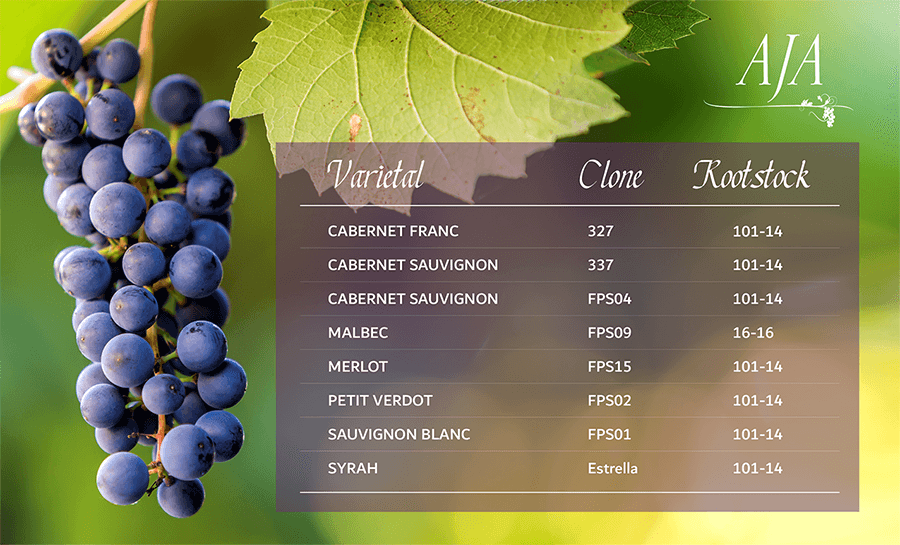
Have you ever checked out our Our Wines page? Did you know we list the different rootstocks and clones of our wines?
You’re probably thinking: wait, Amanda, did you just say clones? There’s more than one type of Syrah?
Yes. There’s also more than one type of Cabernet Sauvignon, Chardonnay, Pinot Noir, Sauvignon Blanc, and almost every grape variety out there. They’re called clones, and they’re extremely important to the way a wine grows, develops, and eventually tastes.
If you’ve ever seen “Clone 4,” “Wente Clone,” or “FPS 01” on a wine label, those are some common clones of very popular varieties. You and I might know them simply as Cabernet Sauvignon, Chardonnay, and Sauvignon Blanc, but a vineyard manager and a winemaker look at them differently. To understand why, we have to go back to the basics.
A Quick Grape Biology Lesson
Most European grape varieties fall under the category Vitis Vinifera, a combination of the genus name for a grapevine, vitis, and the species name for this wine and table grape, vinifera.
Back in the 1860s, winemakers discovered phylloxera, a deadly root louse that wiped out half of Europe’s vineyards. To save the vines, winemakers had to use phylloxera-resistant rootstocks, found in other vitis species like the United States’ Vitis Labrusca. Though Labrusca grape varieties aren’t common on their own, Labrusca rootstock is under most of the world’s vines today. Wineries used a process called grafting to fuse Vitis Labrusca rootstocks to Vitis Vinifera vines, you can spot this in a vineyard by looking for what looks like a giant knot at the base of the trunk.
Now, Let’s Talk About Wine Clones
Each individual variety, Cabernet Sauvignon, Sauvignon Blanc, Petite Sirah, and more, has its own set of clones. Clones are mutations of a specific variety, generally developed through adaptation to climate, soil, and surroundings. As vines spread to different parts of the world, mutations, both natural and intentional, created wines from the same variety that taste slightly different from one another.
Cabernet Sauvignon is an easy example, since it’s one of the most widely planted varieties in the world. It has clones like FPS 04, 337, and FPS 12, all Cabernet Sauvignon, but each accentuating different aspects of the variety. Some clones suit cooler climates better, some suit warm climates. Some have less tannin or fewer pyrazines, others are bolder and more austere. Some have smaller berries, like FPS 04, others have larger ones, like 337.
Why Clones Matter
Beyond accentuating certain elements of the fruit, clones let us plant the same variety successfully in different regions of the world. Selecting the right clone takes an understanding of both the plant and the climate: a winemaker and vineyard manager have to determine which clones, and which rootstocks, will grow best in a given region. Without the right rootstock, a vine can struggle to pull nutrients from the soil or fail to produce fruit and foliage.
When a winemaker sets out to make a particular style of wine, clone selection helps guide the decision. California Cabernet Sauvignon and Bordeaux Cabernet Sauvignon taste quite different even though they’re the same grape. A Californian winemaker chasing a more Bordeaux-like style would likely reach for clones that hold onto more acidity and ripen a little earlier, paired with a yeast strain suited to producing darker color and flavors like tobacco and damp earth from higher pyrazine levels.
Clones aren’t the only factor that determines a wine’s flavor. But if clones were an ingredient in baking chocolate chip cookies, they’d be the type of flour.
Hope you learned something interesting today to share with friends and family.
Cheers!